


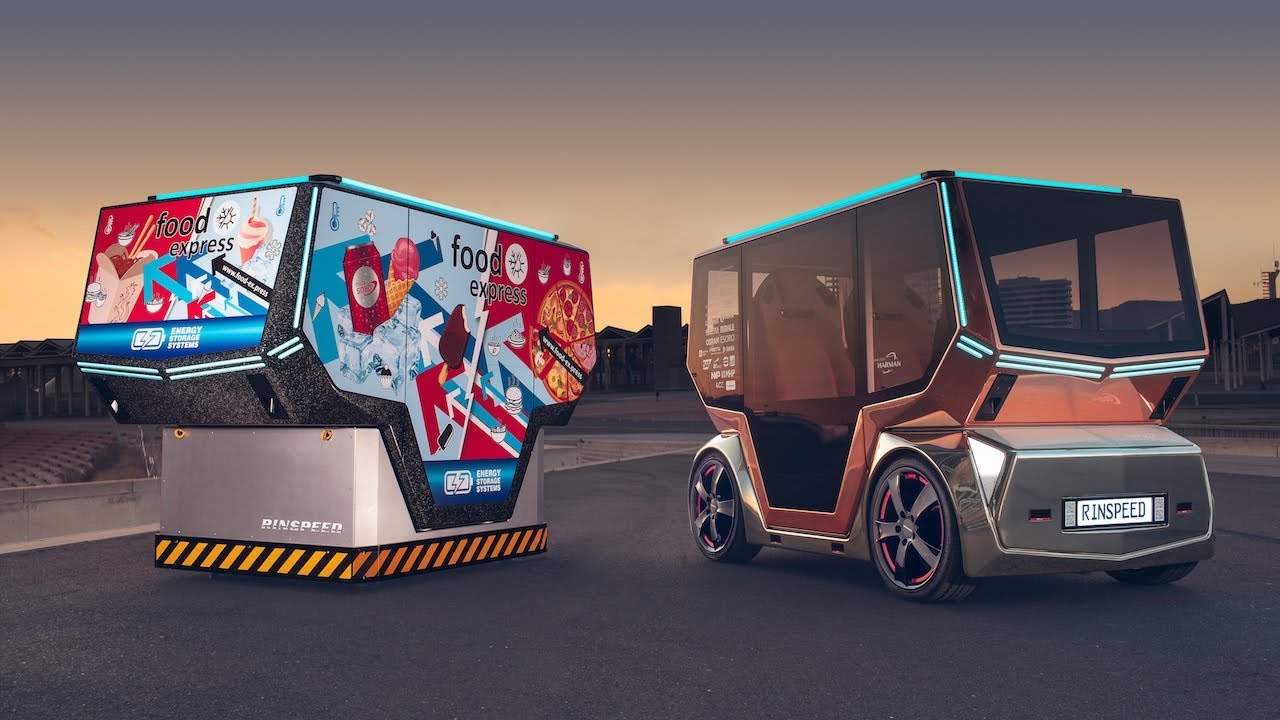
 As far as the Swiss automotive visionary is concerned, the days of large delivery vehicles that serve customers in sequence like pearls on a string over the course of the day are over. Because online business is booming and now includes the fresh food sector as well, the Swiss national believes in small autonomous vehicles that swarm out and bring their goods to the customer without detours and ‘just in time.’ It couldn’t be faster or more simple - even refrigerated or heated. However, his vision also includes two-seater ‘robo units‘, which take the shortest route to convey their passengers to their destination efficiently and in comfort. Rinderknecht is certain: “Customers increasingly want prompt deliveries and many passengers are unwilling to use shared taxis, which have to take time- consuming detours by design.”
A startup is now on the drawing boards and talks with investors are underway to put the “Snap” on the road. In fact, the response among automotive experts to the revolutionary “Snap” is tremendous and not without leaving its mark. Even one of the most renowned automakers was inspired by the Swiss and recently presented its own interpretation of the “Snap” systematics. And since imitation is generally considered the sincerest form of flattery, Rinderknecht takes it with a sense of humor and smiles: “Well now, who did invent it?”
Be it the “Snap” or the “microSNAP,” the basic idea is the same: While the bodies last as long as a car does today, the chassis contain all the components that are subject to wear and aging, such as the computer technology for autonomous driving. “Skateboards” (chassis) and “Pods” (bodies) are only temporary companions for brief periods. Various types of bodies use whatever skateboards are currently available. The skateboards are recycled after a few years, because they will have reached the end of their service life. They thus elegantly avoid an expensive and complicated hardware update.
In keeping with an established tradition, the twenty-fifth concept car from Rinspeed was again designed at Swiss company 4erC and constructed at Esoro, which also handled the technical implementation. As always when Rinderknecht is at work, the electric vehicle is chock-full of technical and visual treats contributed by a network of renowned companies from around the world.
The robotics system and the automated loading aid system come from Kuka in Augsburg. Osram supplies the entire lighting technology including the digital license plate and a micro-pixel LED, which makes dazzle-free high beams possible. The exterior lights communicate with other road users. The interior lights adapt to the driver’s personal mood with the help of health-tracking functions. For the headlights of the “microSNAP,” Rinspeed relies on state-of-the-art LED technology as well as on the innovative product solutions from Prettl Lighting & Interior in Pfullingen. The propulsion of the “microSNAP” is provided by a 48-volt traction motor from the internationally leading development partner and supplier Mahle, whose integrated systems solutions are putting their stamp on the mobility of today and tomorrow across all types of powertrains.
Thanks to high-speed communication and short latency times, the connection to the Harman Ignite Cloud platform via 5G telematics ensures the efficient operation of the autonomously driving “microSNAP.”
CES 2019: Rinspeed presents the further advanced “Snap” ecosystem with the “microSNAP” computadora lenovo | |
| 13 Likes | 13 Dislikes |
| 319 views views | 26.9K followers |
| Science & Technology | Upload TimePublished on 8 Jan 2019 |

Không có nhận xét nào:
Đăng nhận xét